Style & Presence · July 31, 2026 · 6 min read
Why Nothing Ever Fits — It's the Grading, Not Your Body
Clothing sizes are scaled up and down from a single sample size, mostly in width. That one industry shortcut explains almost every fit problem you've had.
Most clothes don't fit because they were never drafted for a body like yours. A brand patterns one sample size on one fit model, then scales that single pattern across the whole size run. The scaling adds width fast and length slowly, so two sizes out, the shoulder, armhole and waist seam land nowhere near you.
That process has a name — grading — and it's the most consequential thing about your clothes that nobody tells you. It isn't sloppiness: drafting a fresh pattern for every size would mean eight or ten design processes per garment, so the industry drafts one and stretches it mathematically in both directions.
The catch is what gets stretched. Circumference scales generously. Vertical measurements barely move: armhole depth, shoulder-to-waist distance, where the knee break sits, how deep the rise runs. Three sizes above the sample, a garment can be inches wider around while sitting almost the same distance from shoulder to hem — a differently proportioned thing, not a bigger version of the same thing.
The label offers no explanation for that, so you supply your own, and the one you reach for is usually about you. It isn't about you. The garment is what has a shape problem. You're just the one standing in it.
What is grading, and why does it matter?
Grading scales one master pattern into a full size run using fixed increments called grade rules. A typical rule adds a couple of inches of circumference per size but only a fraction of an inch to armhole depth or shoulder-to-waist length. Width and length grow at wildly different rates, and every seam placement drifts as you move away from the sample size.
Once you know that, the mysteries resolve. The shirt that binds under the arm isn't badly made — its armhole was drafted for the fit model's torso and barely adjusted after. The dress whose waist seam sits on your ribs was graded for width, not shoulder-to-waist length. The trousers whose knee break lands mid-shin were graded around, not down. None of it is visible on a hanger, which is why fitting rooms feel arbitrary: you're not testing a size, you're testing whether a stranger's proportions resemble yours.
Why sizing up makes things worse in a different way
Sizing up solves exactly one problem and creates several new ones. Because width grows far faster than length, the next size adds a couple of inches around the entire garment while moving the shoulder seam, armhole and waist seam barely at all. You get room where you were tight and excess fabric everywhere else, in one move.
If your hips and waist differ by more than the pattern assumes, you're forced to buy for the widest measurement and accept a tent everywhere else — the mechanic behind why waist-to-hip difference wrecks off-the-rack fit. And the extra volume isn't neutral: it reads as borrowed, because the seams no longer sit on the joints they were drawn for. A shoulder seam an inch off your shoulder point is visible across a room, even when nobody can name what they're noticing.
Why no two brands agree on a size
Because there's no enforced standard. The US Department of Commerce withdrew its voluntary standardised sizing regulations in 1983, and nothing replaced them with any authority. Since then every brand sets its own sample measurements, picks its own fit model, and writes its own grade rules. A size label is a brand's internal shorthand, not a unit of measurement.
That's why your size swings two or three notches in one shopping trip, and why it shifts within a brand across product lines or years, as fit models change. Comparing sizes across brands is a category error, like comparing two companies' part numbers: real inside one system, meaningless outside it. Stop reading it as information about your body and a tedious source of self-criticism goes away.
Which measurements should you actually trust?
Trust the garment's own measurement chart in inches or centimetres and ignore the letter or number entirely. Then buy for what you can't change: shoulder width, armhole depth, and rise. Those are structural — built into how the pattern was cut, and unmovable without rebuilding the garment. Everything else is negotiable.
Take four numbers off yourself once with a soft tape — shoulder to shoulder, chest, natural waist, fullest part of the hips — plus an inseam you like, and keep them in your phone. Then measure a garment you love, laid flat, and use that as your reference. You're matching numbers now, not shopping for a size. Rise matters most, because it sets where a whole garment sits and once it's wrong nothing below it can be right — most of what's going on in finding jeans that work with your build.
What can and can't be fixed after you buy
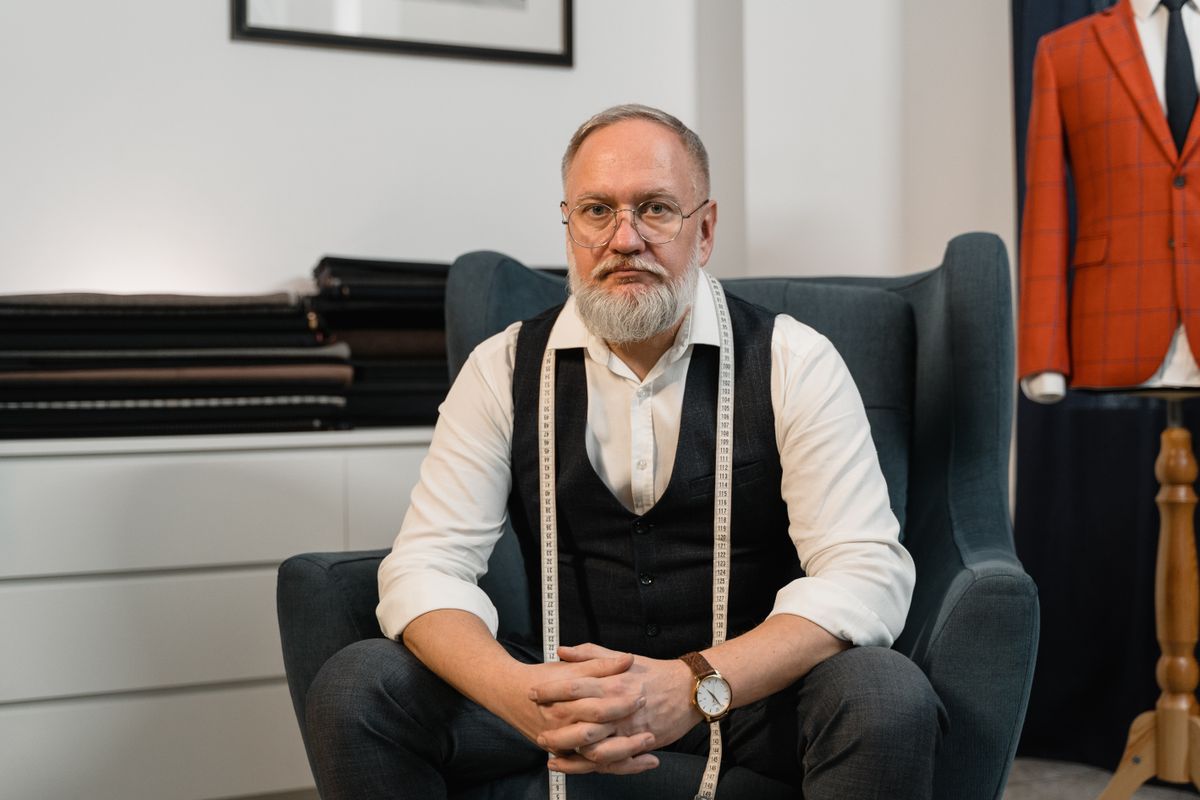
Cheap to fix: taking in a waist or side seams, shortening sleeves at the cuff, hemming a leg, tapering a trouser. Those sit at the edges, where a tailor works without touching structure. Expensive or not worth it: shoulders, armholes, a rebuilt rise — that means dismantling the parts the garment hangs from.
So the shopping rule falls out of the grading problem: buy the size that fits your shoulders and armhole even if the waist looks absurd, then pay someone to take the waist in. A waist adjustment or hem costs a fraction of the garment; reworking a shoulder can cost more than the piece is worth. You're not hunting for the size that fits best overall — you're hunting for the one that fits the parts nobody can alter.
What ill-fitting clothes actually cost you
Not attractiveness. Attention. A garment that pulls, rides up or gapes needs constant management, and every adjustment is a small withdrawal from the attention you'd otherwise spend on the person in front of you. Nobody clocks your armhole depth. They do clock that you keep tugging your sleeve, and they read it — wrongly — as distraction, or discomfort with them.
Clothes that fit are just clothes you forget about. That's the whole benefit, and it's bigger than it sounds, because the alternative is a low hum of self-monitoring the entire time you're out. It's most of what people pick up on in what your clothes say before you speak: not style, but ease.
So here's the shift worth keeping. You've been reading a manufacturing shortcut as a verdict on your proportions. The pattern was drawn for someone else and stretched to reach you — a garment problem, with a garment solution.
Want somewhere to show up as yourself? Snaptle connects you with real, moderated, verified-real people by shared interest, then lets you take it to Snapchat — so the version of you that isn't fussing with a sleeve is the one people meet. It's a connection app, not a dating app: 18+, free on iOS and the web.
Find your people on Snaptle
A free way to connect with creators, grow your audience, and make real friends — no pressure, just good company.