Style & Presence · July 31, 2026 · 6 min read
Why Your Jeans Gap at the Back Waist (and 4 Fixes, Ranked by Effort)
The gap between your jeans and your lower back is a pattern-cutting problem, not a body problem. Here are four fixes, from free to tailored, in order of effort.
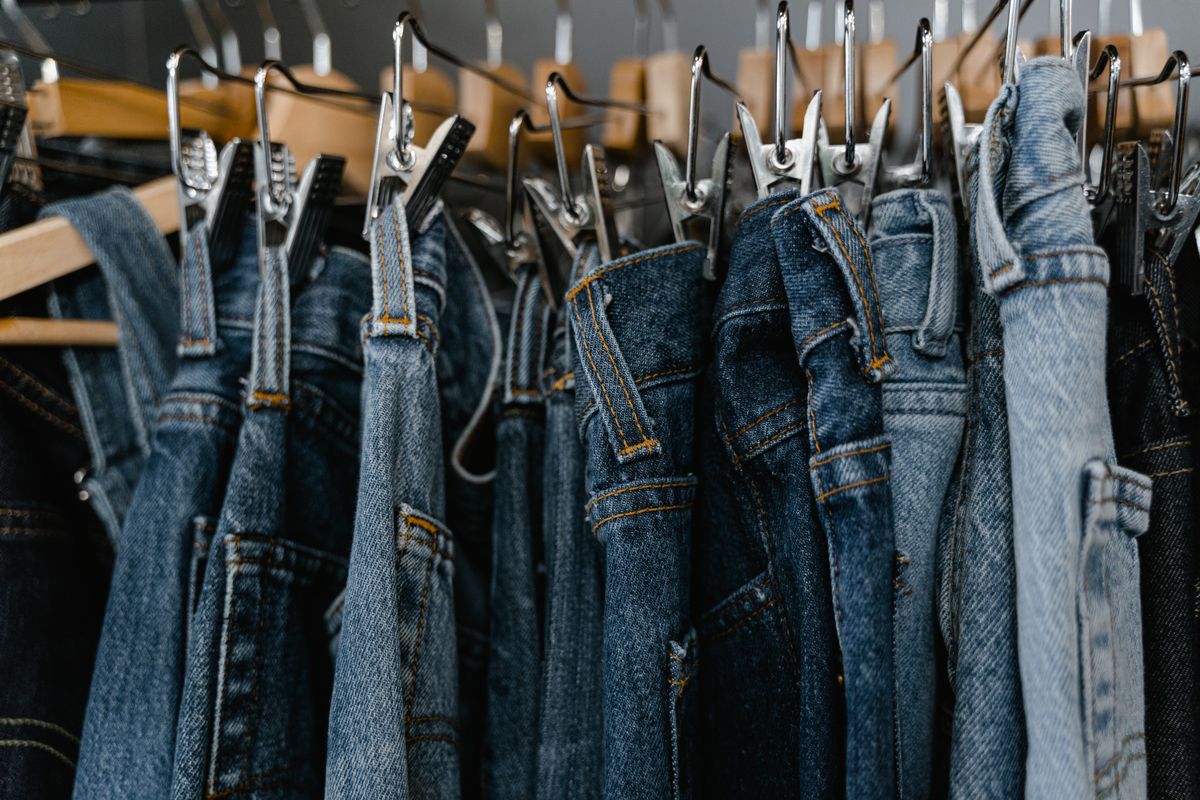
Your jeans gap at the back waist because the waistband was cut for a straighter waist-to-hip line than yours. If the hips fit and the waist stands away, the band is spanning a curve it was never shaped for. There are 4 fixes: change the rise, add a belt, buy a curved waistband, or have a tailor take out a wedge.
Notice what that sentence does and doesn't say. It describes a garment. It says nothing about you — and that's worth being stubborn about, because a gapping waistband quietly gets read as a verdict, as if the denim were reporting something true. It isn't. Denim is cut flat, in stacks, to a fit block that averages thousands of bodies into one imaginary one. When the curve of your lower back is steeper than the block assumed, a straight band bridges it like a plank across a dip, and the space underneath is the gap.
The reason it's worth fixing isn't appearance. It's attention. A gapping waistband means you reach back to check it — in a queue, mid-conversation, walking into a room. Each reach is half a second of your focus pulled off the person in front of you and onto yourself. Do that thirty times in an evening and you've spent a meaningful slice of the night monitoring your own clothes instead of listening. Ill-fitting clothes don't cost you attractiveness; they cost you presence.
So here are the four fixes, in order of what they'll cost you in effort and money. Work down the list and stop as soon as one works. Most people never need to reach number four.
What causes the gap in the first place?
The gap is a mismatch between two measurements: your waist and your hips. Jeans are cut to a fixed difference between those two — often around 8 to 10 inches on a standard block. If your own difference is larger, the waistband that comes attached to hips-that-fit will be too big by exactly the surplus. The fabric has nowhere to go, so it stands off your lower back.
Two other things make it worse. First, denim with little stretch can't ease around a curve, so it stiffens into a hoop rather than following you. Second — and this is the big one — the rise. Where the band sits determines how steep the curve it has to cross actually is. That's the lever most people never think to pull, and it's free.
Fix 1: a different rise (free)
Try the jeans you already own at a different rise before you spend anything. A high rise sits at your natural waist, the narrowest point, where the change from waist to hip is gentlest — so a straight band has the least curve to span. A low rise sits down on the fullest part of the curve, where the shape changes fastest across the smallest vertical distance. That's why low-rise gaps worst.
This is a shopping instruction as much as a fix. Next time you're in a fitting room, take the same jean in high and mid rise and look only at the back. Most people find the gap shrinks by more than half just by moving the band up two inches. Nothing about you changed — the band simply moved to an easier place to sit. If you want the underlying logic in full, it's the same one behind how your waist-to-hip difference drives clothing fit across everything from trousers to coats.

Fix 2: a belt or waistband insert (cheap)
A belt is the five-minute answer, and it's fine. Cinching the band pulls the surplus in and closes the space. Two caveats: a thin belt on a wide gap creates a bunched, ruched look at the back because all the excess gathers at the buckle points, and a very tight belt reintroduces the fidget you were trying to remove. A wider belt distributes the pull better.
The tidier version is an elastic waistband insert or a set of clip-in tighteners — a few dollars, no sewing, tucked inside the band. They pull the excess in from the sides rather than the front, which spreads the gather. Good for one troublesome pair; not a strategy for a whole wardrobe.
Fix 3: curved-waistband jeans (buy better next time)
Some jeans are cut with a contoured or curved waistband — the band itself is shaped, not a straight strip, so it follows the dip of your lower back instead of bridging it. Look for the words "curve", "contour", "shaped waistband", or a larger stated waist-to-hip difference in the size chart. This is the fix that solves the problem permanently, because you stop buying the wrong pattern.
It costs nothing extra beyond ordinary jeans money, and it's the one that scales: once you know the phrase to search for, every future pair is right on arrival. The same principle drives the rest of how to choose jeans that fit your build — you're matching a pattern to a body, not the other way around.
Fix 4: a tailor takes in the back yoke (~$15–25)
For a pair you love and can't replace, take them to a tailor and ask them to take a wedge out of the centre back. They'll open the waistband at the centre-back seam, remove a triangle of fabric through the yoke — wide at the top, tapering to nothing where the seam meets the seat — and close it back up. That taper is the whole trick: it removes width exactly where the surplus is and none where the hips need it.
Ask for it by name — "take a wedge out of the centre-back yoke" — and most shops will quote around $15 to $25 and turn it around in a few days. It's routine work, and on a contrast-stitched centre seam it's nearly invisible when done well.
The point of fixing it at all
Run the list top down: rise, belt, curved band, tailor. Stop at the first one that works. It's a decision tree, not a checklist, and most people solve it at step one or three.
And then forget about it, which is the actual goal. A waistband you never think about is a waistband that has stopped taking small withdrawals from your attention all evening. That's the entire mechanism behind looking effortlessly put together: not a better body, not better taste — just clothes that have stopped interrupting you, so the whole of you is available for the room you're standing in.
Want somewhere worth showing up to? Snaptle connects you with real, moderated, verified-real people by shared interest, then lets you take it to Snapchat — so the version of you that isn't checking a waistband gets to do the talking. It's a connection app, not a dating app: 18+, free on iOS and the web.
Find your people on Snaptle
A free way to connect with creators, grow your audience, and make real friends — no pressure, just good company.